Overview of Prenatal Ultrasound
Prenatal ultrasound is a diagnostic imaging method that uses high-frequency sound waves (2-18 MHz) to create images of the fetus in the uterus. It is the most important tool in pregnancy monitoring, helping doctors assess fetal development, detect abnormalities, and ensure the health of both mother and baby.
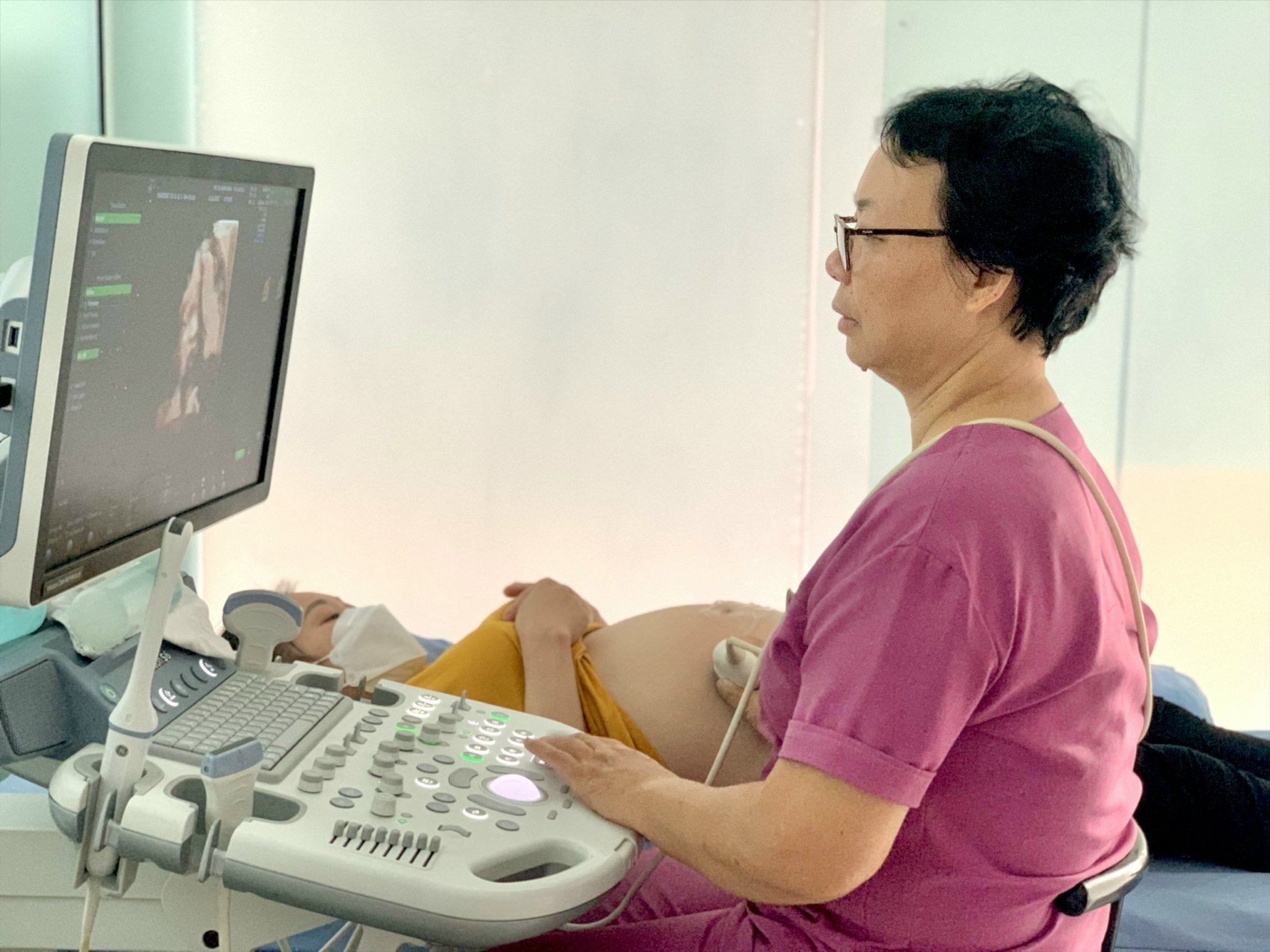
At Phòng Khám Bác Sỹ Lâm, we are equipped with a modern ultrasound system featuring full 2D, 3D, 4D, and Doppler capabilities, enabling comprehensive pregnancy monitoring for expectant mothers in Lao Cai.
2D Ultrasound — The Gold Standard in Diagnosis
Features
2D (two-dimensional) ultrasound creates flat cross-sectional images of the fetus, displayed on screen in grayscale. This is the most basic and common type of ultrasound, used at every prenatal visit.
Advantages
- Diagnostic standard: Allows accurate assessment of fetal anatomy — heart, brain, spine, kidneys, limbs, digestive system
- Precise measurements: Crown-rump length (CRL), biparietal diameter (BPD), head circumference (HC), abdominal circumference (AC), femur length (FL) to estimate gestational age and weight
- Evaluates amniotic fluid, placenta, cervix
- Quick to perform, no special preparation needed
Role at Each Stage
- Weeks 6-8: Confirm intrauterine pregnancy, count embryos, detect heartbeat
- Weeks 11-13: Nuchal translucency (NT) measurement — screening for Down syndrome and chromosomal abnormalities
- Weeks 18-22: Morphology scan — detailed examination of all fetal anatomical structures
- Weeks 28-32: Fetal growth assessment, placental position, amniotic fluid volume
- Weeks 36-40: Weight estimation, fetal presentation, amniotic fluid index
3D Ultrasound — Three-Dimensional Imaging
Features
3D ultrasound creates static three-dimensional images of the fetus by combining multiple 2D cross-sections using software. 3D images show the baby’s body surface similar to a real photograph.
Advantages
- Intuitive images: Mother and family can easily recognize the baby’s face, hands, and feet
- Detects surface defects: Cleft lip, cleft palate, limb defects, abdominal wall abnormalities — clearer than 2D
- Evaluates skull and facial bones: More detailed when abnormalities are suspected
- Diagnostic support: Provides additional perspectives to complement 2D ultrasound
Limitations
- Depends on fetal position and amniotic fluid volume
- Cannot replace 2D for evaluating internal structures (heart, brain, organs)
- Requires skilled and experienced operators
4D Ultrasound — Real-Time Moving Images
Features
4D ultrasound is essentially continuously moving 3D ultrasound in real time. The “fourth dimension” is time — allowing observation of the fetus moving, yawning, sucking their thumb, smiling, or grimacing.
Advantages
- Observe fetal behavior: Recognize movements and facial expressions
- Functional assessment: Watch the baby swallow amniotic fluid, make breathing movements, and reflexes
- Detect movement abnormalities: Abnormal limb movements, seizures
- Emotional experience: Creates a bond between parents and baby before birth
Best Timing
- Weeks 20-24: Baby is still small, plenty of room to move, full body visible
- Weeks 26-30: Ideal timing — baby’s face is plump, amniotic fluid is adequate, still enough space
- After week 32: Baby is large, less space, difficult to capture comprehensive angles
Limitations
- Image quality depends on many factors: baby’s position, amniotic fluid volume, maternal abdominal wall thickness, placental position
- Not always possible to capture beautiful images
- Higher cost than 2D ultrasound
Doppler Ultrasound — Blood Flow Assessment
Features
Doppler ultrasound uses the Doppler effect to assess blood flow in maternal and fetal blood vessels. There are two main types:
- Color Doppler: Displays blood flow in color (red — flow toward the probe, blue — flow away from the probe)
- Pulsed Doppler: Measures speed and waveform of blood flow, providing assessment indices
Clinical Role
Evaluating utero-placental circulation:
- Uterine arteries: Assessing risk of preeclampsia and placental circulation impairment
- Umbilical artery: Reflects placental resistance, early detection of chronic fetal distress
- Fetal middle cerebral artery: Assessing fetal anemia and oxygen deprivation
Fetal heart assessment:
- Flow through heart valves
- Detecting structural heart abnormalities
- Evaluating fetal cardiac function
Indications
- Intrauterine growth restriction
- Gestational hypertension, preeclampsia
- Multiple pregnancy
- History of stillbirth
- Rh blood group incompatibility
- Oligohydramnios, polyhydramnios
- Suspected fetal heart defects
Recommended Ultrasound Schedule During Pregnancy
| Gestational Week | Ultrasound Type | Main Purpose |
|---|---|---|
| 6-8 | 2D transvaginal | Confirm pregnancy, heartbeat |
| 11-13 | 2D + Doppler | Nuchal translucency, screening |
| 18-22 | 2D + 3D/4D | Detailed morphology scan |
| 26-30 | 2D + 4D | Growth assessment, 4D images |
| 30-32 | 2D + Doppler | Growth, circulation |
| 36-38 | 2D | Fetal presentation, weight, fluid |
At Phòng Khám Bác Sỹ Lâm
The clinic is equipped with a modern ultrasound system with full 2D, 3D, 4D, and color Doppler capabilities. BSCKI. Trần Thị Thúy Lâm, with over 30 years of obstetric ultrasound experience, ensures that every scan provides accurate diagnostic information and an impressive experience for expectant mothers.
Advice from the Doctor
BSCKI. Trần Thị Thúy Lâm recommends that expectant mothers follow the ultrasound schedule at the key milestones outlined above. Each ultrasound has a specific medical purpose, and none should be missed because each time window has a limited “window” for detecting abnormalities.
Important notes for prenatal ultrasounds:
- Bring your prenatal record and previous ultrasound results so the doctor can compare fetal development across stages
- Do not have too many ultrasounds without medical indication. Although ultrasound is safe, it should only be performed when there is a clear diagnostic purpose
- 4D image quality depends heavily on the baby’s position, amniotic fluid volume, and maternal body type. If the first scan doesn’t produce a good image, you can try again after 1-2 weeks
- 2D ultrasound remains the foundation — don’t focus only on 4D images while ignoring important medical indices from 2D
- Ultrasound results should be interpreted by a specialist — do not self-interpret images, as many normal structures can be mistaken for abnormalities without professional expertise
For high-risk pregnancies (mothers over 35, history of birth defects, diabetes, hypertension), the ultrasound schedule should be more frequent and combined with Doppler to comprehensively assess fetal status.
Related Articles
- 4D ultrasound: The best timing — More details about 4D ultrasound during pregnancy
- Important prenatal checkup milestones — Complete prenatal schedule for expectant mothers
- Prenatal screening tests — Double test, Triple test, and NIPT
See also: Prenatal ultrasound services | Prenatal care services
Phòng Khám Sản Phụ Khoa Bác Sỹ Lâm — Address: 125 Hàm Nghi, Kim Tân, Lào Cai
Book an appointment: 0986 321 000 — Modern prenatal ultrasound, accurate diagnosis, accompanying expectant mothers every step of the way.