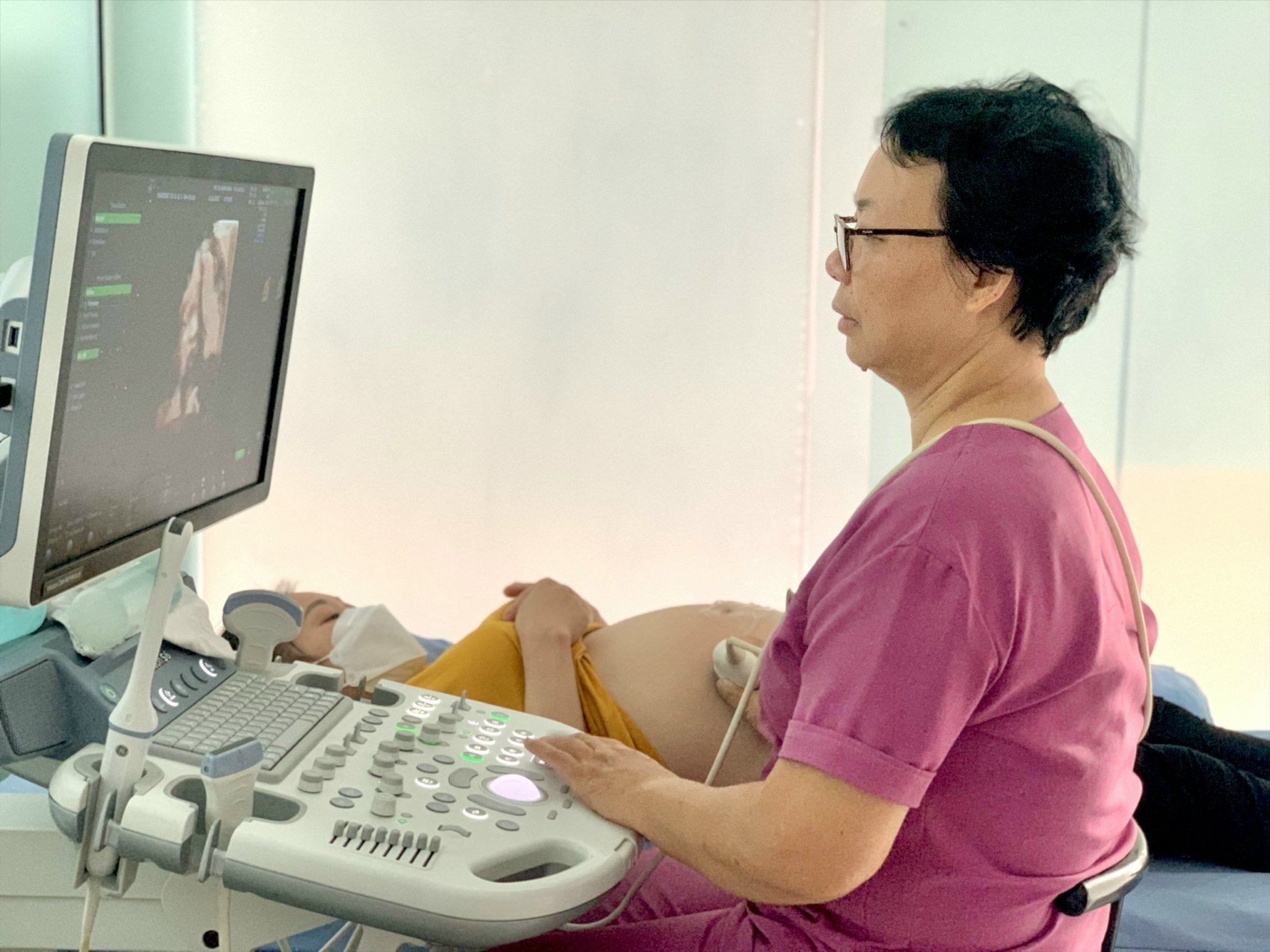
Overview of Prenatal Milestones
Throughout 40 weeks of pregnancy, there are several especially important prenatal milestones that expectant mothers should not miss. With over 30 years of prenatal care experience, BSCKI. Tran Thi Thuy Lam — formerly at Hanoi Medical University Hospital and Medlatec Hospital — emphasizes that missing these milestones may cause mothers to lose the opportunity for early detection of fetal abnormalities that cannot be redone.
This article provides a detailed summary of all prenatal milestones from week 5 through week 40, helping mothers proactively plan their checkup schedule without missing any.
Why Is It Important to Have Checkups at the Right Milestones?
Each prenatal milestone is designed to detect issues specific to each stage of fetal development. Not every milestone can be postponed or repeated:
- Weeks 11-13+6: Nuchal translucency (NT) measurement is only accurate during this window — before week 11 the baby is too small, after week 14 the NT naturally disappears
- Weeks 20-22: The baby is large enough to evaluate structures but not yet too cramped — the only time to clearly observe all organs
- Weeks 24-28: Gestational diabetes typically appears in the second half of pregnancy — testing earlier may give false negative results
3 Prenatal Milestones You MUST NOT Miss
Milestone 1: Weeks 11-13+6 — First Trimester Screening
This is the first irreplaceable milestone.
Why is it important?
- Measures nuchal translucency (NT) — screening marker for Down, Edwards, and Patau syndromes
- Double test (Combined first trimester screening) — combines NT + maternal blood test to calculate risk
- Confirms the most accurate gestational age (margin of error only 3-5 days vs. 7-10 days in later weeks)
- Detects multiple pregnancies and determines type (monochorionic or dichorionic)
- CANNOT BE REDONE if this window is missed
Detailed content:
- NT ultrasound: Normal below 2.5 mm. NT above 3.0 mm indicates high risk
- Nasal bone assessment: Absent nasal bone increases Down syndrome risk
- Maternal blood tests: PAPP-A + free beta-hCG
- Combined maternal age + NT + blood tests to calculate risk probability using specialized software
Reading results:
- Low risk (below 1/1000): Continue normal prenatal care
- Intermediate risk (1/250 — 1/1000): Consider NIPT (non-invasive)
- High risk (above 1/250): Consult for advanced screening tests (NIPT or amniocentesis)
Note: Double test + NT detects 85-90% of Down syndrome cases. NIPT detects over 99% but costs significantly more. See prenatal care costs for more information.
Milestone 2: Weeks 20-22 — Fetal Morphology Ultrasound
This is the most important ultrasound of the ENTIRE PREGNANCY!
The morphology ultrasound (anatomy scan) evaluates the entire anatomical structure of the fetus:
Head and brain:
- Cerebral hemispheres, ventricles, cerebellum, posterior fossa
- Detects: hydrocephalus, anencephaly, encephalocele
Heart (4-chamber cardiac ultrasound):
- Evaluates 4 chambers, valves, great vessels
- Detects: congenital heart disease (affects 1% of newborns) — VSD, ASD, Tetralogy of Fallot
Spine:
- Assessment from neck to sacrum
- Detects: spina bifida
Abdomen:
- Stomach, intestines, bladder, kidneys
- Detects: omphalocele, esophageal atresia, polycystic kidneys, hydronephrosis
Limbs:
- Arms, legs, hands, feet, fingers
- Detects: limb defects, clubfoot
Face:
- Eyes, nose, mouth, jaw
- Detects: cleft lip/palate, anophthalmia
Additional assessment:
- Placenta: position, maturity grade
- Amniotic fluid: volume (normal 8-18 cm)
- Umbilical cord: 3 vessels (2 arteries + 1 vein)
The morphology ultrasound requires an experienced doctor and high-quality ultrasound equipment. At Phong Kham BS Lam, this milestone is performed by BSCKI. Pham Hong Thang — Specialist in Diagnostic Imaging, Hanoi Medical University. Combining 2D + 4D ultrasound for the most detailed imaging.
Milestone 3: Weeks 24-28 — Gestational Diabetes Screening
- Oral Glucose Tolerance Test (OGTT):
- Fast 8-12 hours before the test
- Measure fasting blood sugar
- Drink 75 g glucose dissolved in 250 ml water, consumed within 5 minutes
- Measure blood sugar at 1 hour and 2 hours
- Gestational diabetes diagnosis when at least 1 value exceeds threshold: Fasting 5.1 or above, 1h 10.0 or above, 2h 8.5 or above mmol/L
- Gestational diabetes affects 7-10% of pregnant women — higher rate in overweight women, those with family history, and over 35
- If undetected, the baby may be too large (macrosomia), difficult vaginal delivery, risk of emergency cesarean section, neonatal hypoglycemia, severe jaundice
Learn more about gestational diabetes.
Additional Important Prenatal Milestones
Weeks 5-8: First Prenatal Visit
This is the first and most important milestone to:
- Confirm intrauterine pregnancy (rule out ectopic pregnancy)
- Confirm active heartbeat
- Count number of fetuses (singleton or multiple)
- Calculate due date based on CRL (crown-rump length)
Weeks 8-10: Comprehensive Blood Tests
- CBC, ABO blood type + Rh
- HIV, Hepatitis B (HBsAg), Hepatitis C, Syphilis (RPR/VDRL)
- TORCH (if no immunity): Toxoplasma, Rubella, CMV, Herpes
- Thyroid function (TSH)
Weeks 28-30: Tetanus Vaccination
- Tetanus booster (VAT)
- Check for anemia (second CBC)
- Anti-D injection if mother is Rh-negative
Week 36: GBS Test
- Group B Streptococcus test via vaginal-rectal swab
- If positive: prophylactic antibiotics during labor to protect baby
Complete Prenatal Milestone Summary
| Week | Milestone | Content | Level |
|---|---|---|---|
| 5-8 | First visit | Confirm pregnancy, heartbeat, position, due date | Important |
| 8-10 | Comprehensive tests | Blood, blood type, HIV, hepatitis B, TORCH, TSH | Important |
| 11-13+6 | First trimester screening | NT + Double test — CANNOT BE MISSED | Very important |
| 15-20 | Triple test | Supplementary screening (if Double test missed) | Important |
| 20-22 | Morphology ultrasound | Evaluate all fetal organs — MOST IMPORTANT | Very important |
| 24-28 | Diabetes screening | OGTT glucose tolerance test | Very important |
| 28-30 | Visit + vaccination | Tetanus shot, anemia check, Anti-D | Important |
| 32-34 | Growth ultrasound | Estimate weight, amniotic fluid, fetal position, Doppler | Important |
| 36 | GBS test | Group B Streptococcus, delivery readiness assessment | Important |
| 38-40 | Weekly visits | Fetal heart monitoring (NST), amniotic fluid ultrasound, cervical assessment | Important |
Consequences of Missing Prenatal Milestones
| Missed milestone | Specific consequence | Can it be compensated? |
|---|---|---|
| NT + Double test (weeks 11-13) | Lost opportunity for most accurate first-trimester Down screening | Replace with Triple test (weeks 15-20, less accurate) or NIPT (more expensive) |
| Morphology ultrasound (weeks 20-22) | Cannot detect structural defects (heart, brain, spine) | Can scan later but difficult to fully evaluate as baby is larger |
| Glucose tolerance test (weeks 24-28) | Undetected gestational diabetes leads to macrosomia, difficult birth, neonatal complications | Can be done later but loses time for blood sugar control |
| GBS test (week 36) | Unknown GBS status puts baby at risk of neonatal infection | Can test during labor but results are delayed |
Prenatal Milestones for High-Risk Pregnancies
If you are in the high-risk pregnancy category (over 35, history of recurrent miscarriage, chronic conditions, previous preeclampsia), the schedule will be more frequent:
- Visits every 2 weeks from week 28 (instead of every 4 weeks)
- Doppler ultrasound from week 26
- Fetal heart monitoring (NST) from week 32
- Additional tests: coagulation, liver/kidney function, 24-hour urine protein
When to See the Doctor Outside the Schedule?
Beyond regular milestones, mothers should come for prenatal care immediately when experiencing:
- Vaginal bleeding — at any stage
- Severe abdominal pain — unrelenting contractions
- Amniotic fluid leaking — before week 37
- Decreased fetal movement — after week 28
- Severe headache, visual disturbances, swelling — suspected preeclampsia
- High fever above 38 degrees Celsius lasting more than a day
Advice From a Specialist
“In over 30 years of practice, I have witnessed many cases of fetal abnormalities detected thanks to timely milestone checkups — Down syndrome detected via Double test, congenital heart disease detected via morphology ultrasound, gestational diabetes detected via OGTT. The most important milestones are weeks 11-13 and 20-22 — these two cannot be redone if missed. I advise all expectant mothers: remember and attend your milestone checkups!”
— BSCKI. Tran Thi Thuy Lam, 30+ years of experience, formerly at Hanoi Medical University Hospital, Medlatec Hospital
Book Your Milestone Prenatal Visit at Phong Kham Bac Sy Lam
Phong Kham San Phu Khoa Bac Sy Lam helps mothers attend milestone checkups with:
- Appointment reminders — The clinic reminds mothers before each important milestone
- Modern 2D & 4D ultrasound machines — sharp imaging, accurate morphology assessment
- Coordination with Medlatec Hospital for screening tests (Double test, Triple test, NIPT) — accurate, fast results
- Consistent doctor following throughout pregnancy — knows your history, misses nothing
Book Now
Call 0986 321 000 to book your milestone prenatal visit.
Address: 125 Ham Nghi, Kim Tan, Lao Cai — Open 7 days/week, 7:00 - 19:00
Every prenatal milestone has special significance — don’t miss any. Book your appointment today!